
BLOG
Reconstituting Peptide Powder Without Guesswork

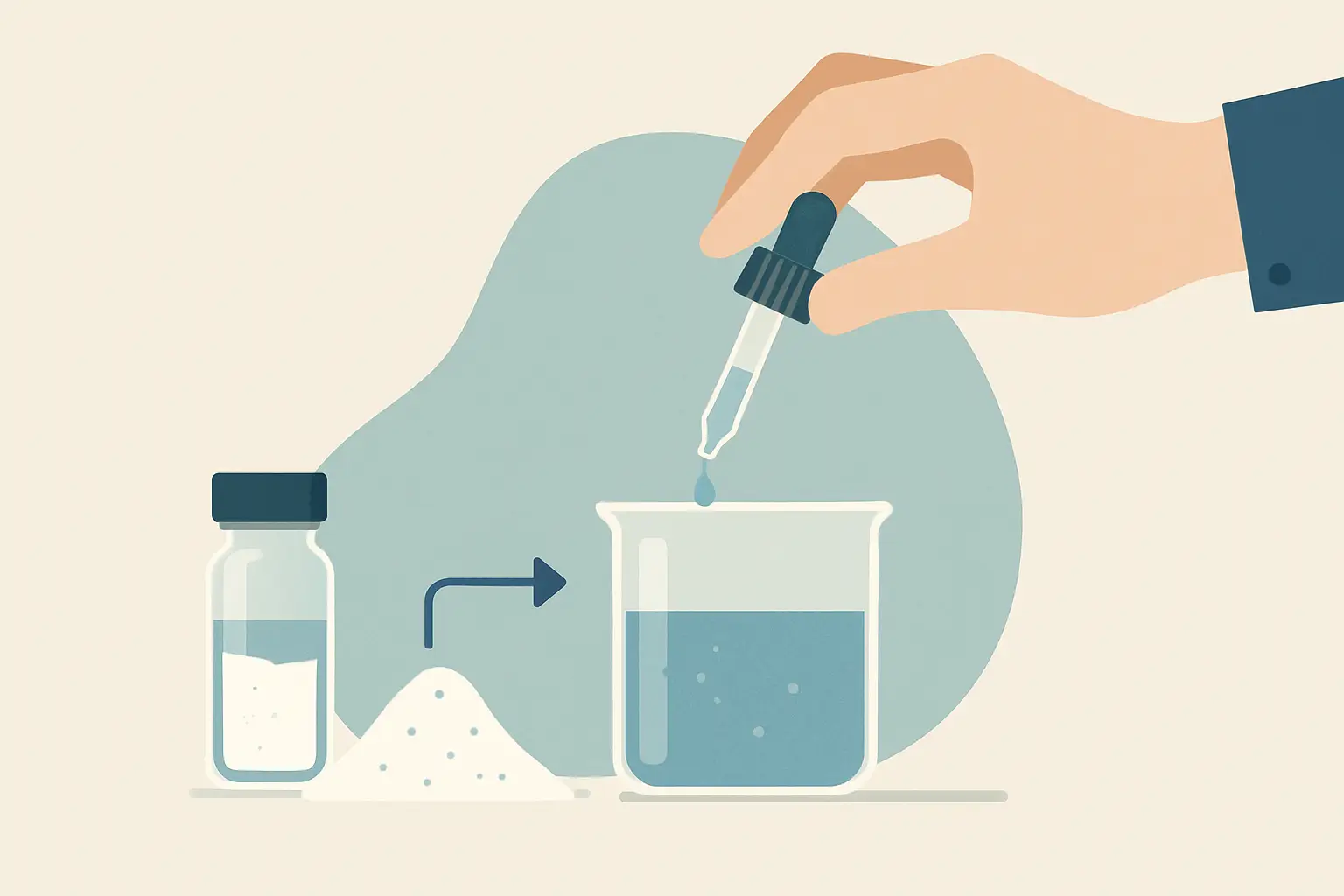
A peptide vial that looks like an “empty” tube is rarely empty. Most research peptides arrive as a thin lyophilized cake or a light film at the bottom of the vial – easy to miss, easy to mishandle, and easy to compromise if your process is casual. Reconstitution is where repeatability is either protected or lost.
This guide is written for research use workflows where documentation, sterility, and concentration accuracy matter. It is not medical guidance and it is not dosing advice.
What “reconstitution” actually means (and what it does not)
Reconstituting a peptide powder means adding a suitable sterile diluent to a lyophilized peptide so it becomes a solution with a known concentration. The goal is a stable, measurable, reproducible stock solution you can use across assays or analytical runs.
Reconstitution does not “activate” a compound, improve purity, or correct for poor storage upstream. If the vial was overheated in transit, repeatedly warmed and cooled, or exposed to moisture before you opened it, your best technique cannot fully reverse that. Good reconstitution is about control – minimizing variability you introduce.
Before you start: choose your concentration on purpose
Most errors happen before a needle touches a vial. Decide what concentration you need based on your planned volumes and measurement capabilities. If your downstream method can only measure in 10-20 microliter increments, creating a solution that requires 1-2 microliter transfers is inviting inconsistency.
A practical target is a stock concentration that keeps routine pipetting volumes comfortably above your minimum reliable volume. That typically means reconstituting to something like 1 mg/mL, 2 mg/mL, or another simple value that makes your math and aliquoting clean.
Also consider whether you need a short-term working solution and a longer-term stock. If stability is a concern, a higher-concentration stock aliquoted into small single-use vials can reduce freeze-thaw cycles and limit time at room temperature.
Materials and environment: sterility is a process, not a label
The most common reconstitution diluent in peptide research is bacteriostatic water, because it includes a preservative that helps limit microbial growth after punctures. For some workflows, sterile water for injection or sterile saline may be used instead. What you choose depends on your protocol compatibility and the compound’s known stability profile.
You will also need sterile syringes and needles (or a needle/syringe system appropriate for vial access), alcohol prep pads, labels, and a way to record lot, date/time, and calculated concentration. If you are working in a lab, a clean bench or biosafety cabinet is preferred. If not, you still need a controlled, low-dust surface and disciplined aseptic handling.
Sterility is not just “wipe the top once.” It is limiting open-air exposure, not touching sterile tips, disinfecting vial stoppers before each puncture, and using new sterile consumables when there is any doubt.
How to reconstitute peptide powder step by step
1) Verify the vial information and your target concentration
Confirm the peptide mass on the label (for example, 5 mg) and confirm your planned final volume (for example, 2.5 mL). Write down the intended concentration before you start. If you are running multiple vials, prepare a small worksheet so you do not rely on memory mid-process.
If the vial indicates “net peptide” vs “salt weight,” use the value your research protocol expects. This is one of those “it depends” details that can cause quiet concentration drift between labs. If you are comparing results across groups, align on the same convention.
2) Let the vial and diluent reach a controlled temperature
If your peptide has been stored cold, let it equilibrate briefly so you are not drawing moisture into the vial from condensation when you open packaging. You do not need to warm aggressively. You need stable handling conditions.
Similarly, if your diluent has been refrigerated, cold liquid can sometimes increase bubble formation and slow dissolution. Room temperature diluent is often easier to work with, assuming your protocol allows it.
3) Disinfect vial stoppers and set up your workspace
Use an alcohol pad to disinfect the peptide vial stopper and the diluent vial stopper. Allow the alcohol to fully evaporate. Wet alcohol can carry contaminants and it can also be drawn into the vial.
Arrange your items so the process is uninterrupted. Reconstitution should be one controlled sequence, not “stop, search for a pen, come back.”
4) Withdraw the diluent accurately
Use a sterile syringe to withdraw your chosen volume of diluent. Accuracy here matters more than people think. A 0.1 mL error is trivial at 10 mL total volume, but meaningful at 1 mL total volume.
If you are using a large volume, it can be cleaner to add in two pulls rather than forcing a single awkward draw. Just document the total volume added.
5) Add diluent gently to protect the peptide
Inject the diluent slowly down the inside wall of the peptide vial rather than blasting directly onto the lyophilized cake. Aggressive force and foaming can increase the risk of denaturation for some peptides and can also leave material stuck higher on the glass.
After adding diluent, do not shake hard. Instead, swirl gently or roll the vial between your fingers. If you see bubbles, let the vial rest until they dissipate.
Dissolution time varies. Some peptides go clear quickly. Others take longer and may require several gentle swirls over a few minutes. If you still see visible particulates after reasonable mixing time, do not assume “that’s normal.” Confirm your diluent choice, check that the vial was not overcooled causing temporary precipitation, and review compound-specific handling expectations.
6) Inspect and label immediately
Once the solution is clear and consistent, label the vial with concentration (mg/mL or mcg/mL), diluent type, date/time, and any internal identifier such as lot number or study ID.
If you plan to aliquot, do it now while your concentration and conditions are fresh and you can document it in one pass.
Reconstitution math that stays clean under pressure
The basic relationship is simple: concentration equals mass divided by volume.
If you have 5 mg and add 2.5 mL total diluent, your concentration is 2 mg/mL.
Many researchers also want micrograms per microliter because it maps to small transfers: 2 mg/mL equals 2,000 mcg/mL, which equals 2 mcg/mcL.
The key is to pick volumes that convert cleanly. A volume that yields 1 mcg/mcL or 2 mcg/mcL makes routine calculations fast and reduces transcription mistakes.
If you need a different working concentration, consider making a secondary dilution from your stock rather than reconstituting the entire vial at a low concentration. That approach usually improves stability and reduces freezer space waste because aliquots are smaller and more standardized.
Storage, stability, and the freeze-thaw problem
Once a peptide is in solution, stability typically becomes more sensitive to time and temperature. Many research teams store reconstituted peptides refrigerated for short-term use and frozen for longer-term storage, often as aliquots sized to avoid repeated punctures.
Freeze-thaw cycles are a predictable source of variability. Each cycle can increase degradation risk, concentration drift from evaporation or adsorption, and contamination exposure from extra handling. Aliquoting into single-use volumes is one of the simplest ways to protect repeatability.
Also consider adsorption to glass or plastic. Some peptides are “sticky,” especially at low concentrations. Using appropriate low-binding labware for aliquots can reduce losses. If your data looks like the compound is weaker than expected, adsorption is a real candidate cause, not a vague excuse.
Common failure points (and how to prevent them)
The biggest preventable issues are not exotic chemistry problems. They are process problems.
Misreading vial mass, using the wrong final volume, and failing to record what you did will haunt you later when results do not replicate. Contamination is another quiet failure: a compromised vial can look normal until it doesn’t.
Over-agitation is also common. Shaking a vial like it is a sports drink can create foam, increase contact with air, and potentially stress fragile peptides. Gentle mixing is slower but more controlled.
Finally, do not ignore the basics of sourcing and documentation. If you are comparing experiments across time, lot-to-lot consistency and accessible test results matter. Suppliers that emphasize verified identity and purity can reduce starting uncertainty. If you are sourcing research peptides, Evergreen Peptides maintains a quality-first, testing-forward approach at https://Evergreen-Peptides.com.
A note on “it depends” scenarios
Not every peptide behaves the same in solution. Some tolerate common aqueous diluents well. Others may be more sensitive to pH, agitation, or storage conditions. Your protocol, analytical method, and expected storage duration should drive decisions like stock concentration, aliquot size, and whether a preservative-containing diluent is appropriate.
If your work is regulated or audited, align your reconstitution SOP with your documentation expectations. A clean label and a clear record of volumes, concentrations, and timestamps are not extra work – they are part of the chain of custody for your data.
A controlled reconstitution process is one of the few places you can remove variability at essentially zero cost. Treat it like a measured step, not a quick chore, and your results will be easier to trust.