
BLOG
HPLC Testing for Peptides, Explained Clearly

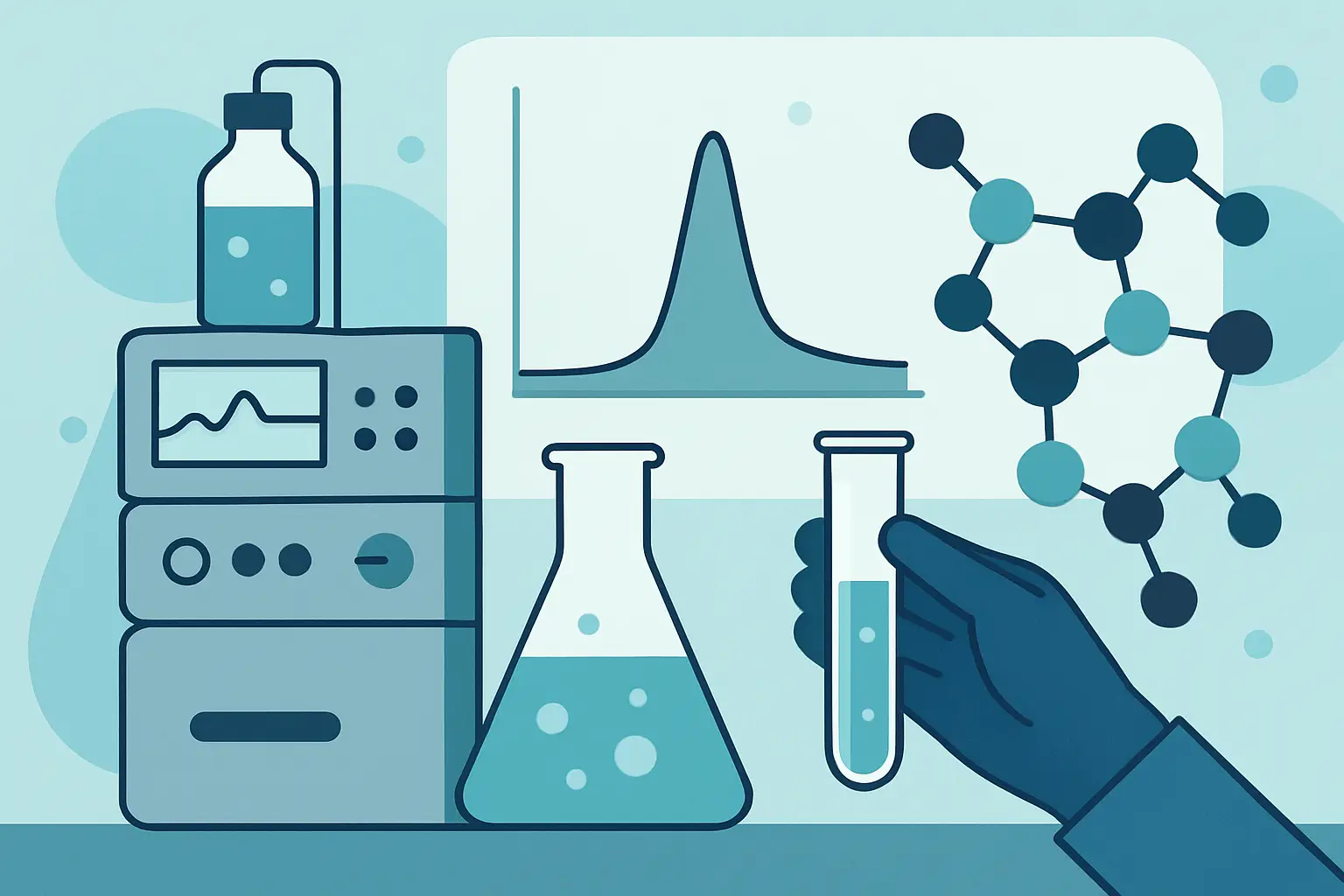
If you are running peptide work where outcomes depend on small differences in material quality, the phrase “HPLC purity” is not marketing. It is a risk control. One extra shoulder peak, one unresolved impurity band, or one lot that behaves differently can cost time, samples, and confidence in your data.
This is HPLC testing for peptides explained in practical terms – what high-performance liquid chromatography (HPLC) actually measures, how purity percentages are produced, what can skew results, and how to interpret a chromatogram like a quality-minded buyer.
What HPLC does (and what it does not)
HPLC separates components in a sample based on how they interact with a stationary phase (the column packing) and a mobile phase (the solvent system). The instrument pushes solvent through a column at high pressure; compounds elute at different times (retention time) and are detected, typically by UV absorbance.
For peptides, HPLC is most commonly used as a purity and consistency check. You inject a known amount of your peptide solution, run a method designed to separate the target peptide from related species, and observe the resulting chromatogram. If the method is well-chosen, the target peptide appears as a dominant peak and impurities appear as smaller peaks at different retention times.
HPLC does not, by itself, prove identity. A single peak at the expected retention time is reassuring, but it is not definitive identification. Different molecules can co-elute, and some impurities can hide under the main peak if the method lacks resolving power. That is why serious verification often pairs HPLC with mass spectrometry (MS) for identity confirmation.
Why peptides are a special case for chromatography
Peptides are not small molecules with one stable form. They can exist as families of closely related species: truncated sequences, deletion peptides, epimers, oxidized variants, deamidated species, and peptide-peptide aggregates. Many of these differences are subtle and can be difficult to separate.
That is why HPLC conditions matter more than the headline purity number. A method that is too gentle can compress everything into one broad peak. A method that is too aggressive can degrade the peptide during analysis or produce distorted peak shapes that make integration unreliable.
For most research peptides, reverse-phase HPLC (RP-HPLC) is the workhorse. It separates based on hydrophobic interactions, usually using a C18 column and a gradient of water and organic solvent with an acidic modifier.
“Purity %” is usually an area percent – and that has implications
When you see “99% purity by HPLC,” it almost always means area percent purity. The software integrates the area under the detected peaks and calculates the target peak area divided by total integrated peak area.
That is a useful metric, but it comes with three practical constraints:
First, the detector response depends on the chemistry. UV absorbance varies by sequence and by impurity type. An impurity with a weak chromophore might be underrepresented, while an impurity with strong absorbance might look larger than it is by mass.
Second, “total integrated area” depends on which peaks are integrated and how the baseline is drawn. Two labs can obtain different purity percentages from the same chromatogram if they use different integration parameters.
Third, HPLC area percent purity does not automatically translate to “99% of the vial is the peptide by weight.” It is a chromatographic purity signal under a defined method and detection wavelength.
For a research buyer focused on repeatability, this is not bad news. It just means you should treat HPLC purity as a method-specific quality indicator and look for consistent testing practices across lots.
The method controls the story: column, gradient, and detection
A peptide HPLC result is only as good as the method used to generate it.
Column selection influences resolution. A typical C18 RP column is common, but pore size and particle size matter for peptides. A column suited for peptides can separate closely related variants more effectively than a generic column.
The mobile phase and gradient determine separation. A shallow gradient can improve resolution (better separation of close peaks) but takes longer. A steep gradient is faster but can merge impurities into the main peak.
Detection wavelength changes what you see. Many peptide HPLC methods monitor 214 nm because peptide bonds absorb strongly there, capturing a broad range of peptide-related species. Some reports use 280 nm for aromatic residues, which can under-detect impurities lacking aromatics. Neither is “wrong,” but they answer different questions.
When you review lab results, you want to know whether the method is appropriate for peptides and whether the supplier uses consistent methods across batches. Changing columns, gradients, or detection settings can shift retention times and alter calculated purity.
How to read a peptide HPLC chromatogram
A chromatogram is a plot of detector response (y-axis) versus time (x-axis). The main things to evaluate are not complicated, but you need to look past the single purity number.
Start with the main peak. A high-quality run typically shows a sharp, symmetrical main peak. Excessive tailing can indicate secondary interactions, column overload, or a method mismatch for the sample matrix. Broad peaks can suggest multiple co-eluting species, aggregation, or suboptimal gradient conditions.
Then check for shoulders and nearby peaks. A shoulder on the main peak is often a warning sign that a closely related impurity is not fully resolved. A method can still report high purity if the shoulder is not separated enough to integrate as its own peak.
Look at the baseline and noise. A stable baseline supports reliable integration. A drifting baseline, spikes, or excessive noise can inflate or distort integration.
Finally, review minor peaks. A few small, well-separated peaks are not automatically a problem – they can reflect typical synthesis-related impurities. What matters is whether those peaks are consistent lot-to-lot and whether they are controlled at acceptable levels for your application.
Common peptide impurities HPLC may reveal
HPLC is especially good at catching “related substances” that differ in hydrophobicity. In peptides, that often includes truncated sequences from incomplete coupling, deletion sequences, and some oxidation products. You may also see residual protecting group artifacts or synthesis byproducts if purification was inadequate.
Some issues are harder. Counter-ions (like acetate or TFA), residual salts, and many inorganic contaminants are not captured well by UV HPLC as “peaks,” even though they matter for handling and reconstitution behavior. Water content and residual solvents also do not present as classic UV peaks.
This is one reason quality-minded suppliers do not rely on a single test. HPLC is a core purity tool, but it is not a complete specification on its own.
What can make an HPLC purity number look better than reality
HPLC can be unintentionally “optimized” into a favorable number if the method is not designed to separate likely impurities.
If the gradient is too steep, closely related impurities can co-elute. If detection is set to a wavelength that under-responds to certain impurities, they may barely register. If the injection is overloaded, peaks can broaden and merge. If integration is set to ignore small peaks or smooth aggressively, the total impurity area can shrink.
None of this requires bad intent. It is often the result of using a generic method rather than a peptide-appropriate method, or reporting a chromatogram without sufficient detail.
For research buyers, the practical takeaway is to prioritize suppliers who consistently publish clear chromatograms, use peptide-appropriate methods, and show repeatable results across lots.
What HPLC cannot tell you (and what to ask for instead)
HPLC cannot confirm molecular weight. If identity matters, mass spectrometry is the standard companion test. HPLC also does not quantify peptide content by mass without appropriate calibration, standards, and often orthogonal approaches.
If your work is sensitive to counter-ions, residual solvents, or moisture, you may need additional documentation or testing approaches. Depending on the compound and use case, that might include MS for identity, Karl Fischer for water, residual solvent analysis, or other controls.
It depends on your application. If you are using a peptide as an analytical reference in a comparative study, lot-to-lot HPLC consistency and identity confirmation may be the priority. If you are doing longer experiments where stability is a concern, you may care more about oxidation markers and storage handling.
Batch consistency: the underappreciated value of HPLC
Many buyers treat HPLC as a one-time gate: “Is it pure enough?” The more operational question is: “Will the next vial behave the same way?”
HPLC is one of the best tools for monitoring batch-to-batch consistency because it provides a repeatable fingerprint under a defined method. When a supplier runs the same method for each lot, retention time and impurity pattern become a comparative record. That is often more useful than a single high purity percentage.
This is also where disciplined documentation matters. Lot numbers, test dates, and method consistency reduce uncertainty for researchers who need repeatable inputs.
Where Evergreen Peptides fits in a quality-first workflow
If you are sourcing research peptides and want a supplier that emphasizes verified purity and batch consistency rather than generic resale, Evergreen Peptides positions its catalog around testing-forward, research-only expectations. The practical benefit is simpler: fewer surprises when you reorder and fewer variables to explain when results shift.
A compliance-forward note on “research use only”
Peptides sold for legitimate research use are not consumer goods, and HPLC data is not a clinical claim. Treat it as quality documentation for materials used in laboratory and investigational contexts by qualified parties. Keep your handling, storage, and recordkeeping aligned with your environment and your protocols.
A useful habit is to treat every new lot like a new input, even if the label is the same. Review the chromatogram, compare it to prior lots if available, and decide whether the impurity profile and reported purity are fit for your intended research. If you do that consistently, HPLC stops being a marketing checkbox and becomes what it is supposed to be: a control that protects your time and your data.